
The Cooking Year From The Cooking Family

A full school-year home cooking curriculum for grades 3 to 12.

Where the homework is dinner.

By the end of this school year, your student will be able to plan, shop, cook, serve, and clean up complete meals for your family, with a recipe or without one.

  • 36 lessons
  • 9 modules
  • Ages 8 to 18
  • One enrollment, whole household
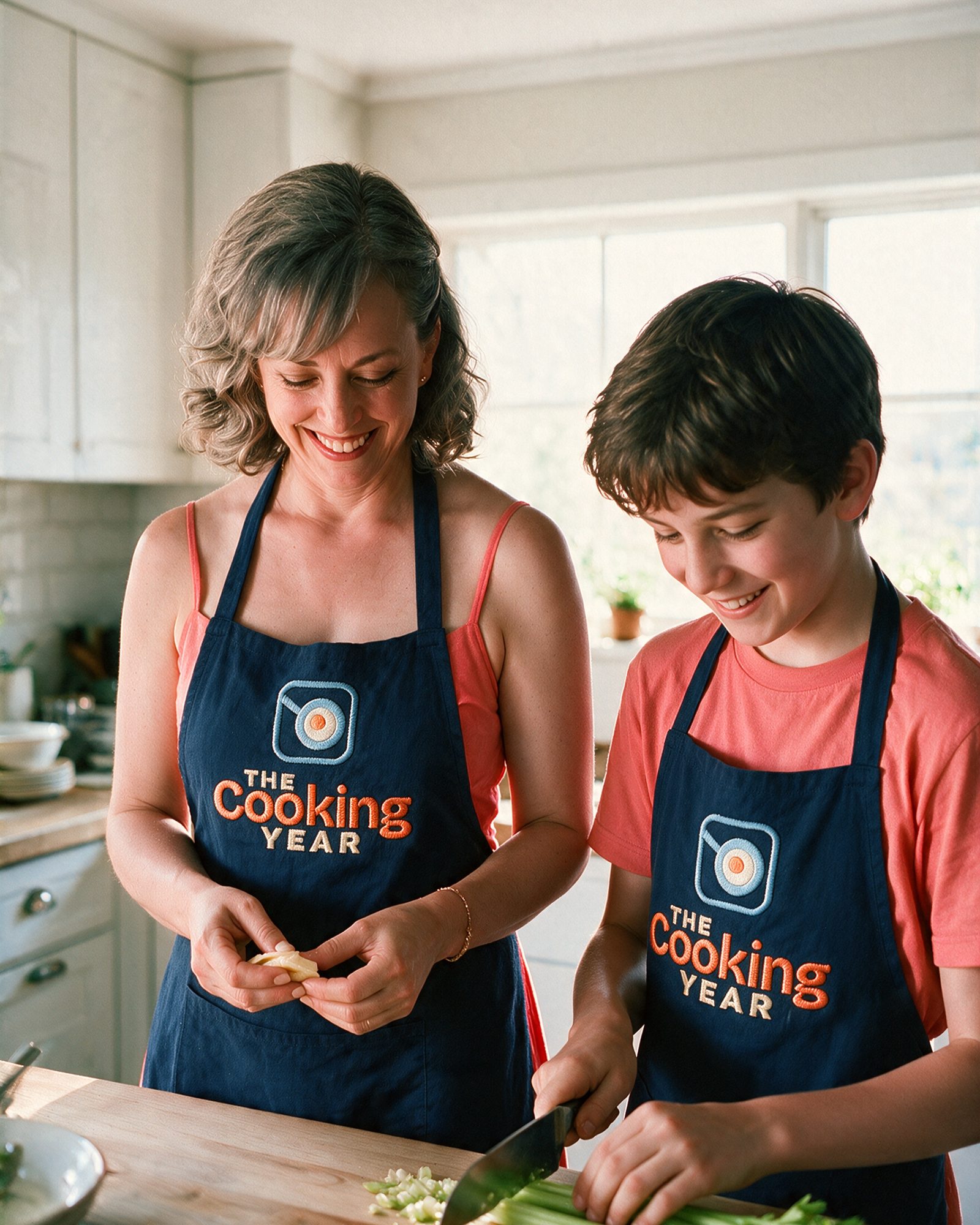
Holly and a student in matching Cooking Year aprons at the counter, the student chopping celery

The only school subject that gets used three times a day…for life!

Think about what your kids actually take with them when they leave your house. If they go through The Cooking Year, they will take the ability to feed themselves and the people around them, every day, for the rest of their lives. There is almost nothing else you can hand a child that pays off that often.

Nine modules. Thirty-six weeks. Every one ends in real food.

Here is every lesson in the year, in order. Your student earns a badge at the end of each module.

Module 1Weeks 1–4

First Fire

Safety, tools, knife skills, and measuring. They cook in the first ten minutes of the first lesson.

Available September 1, 2026

  1. Week 1Let's Get Crackin'

    Your first meal, scrambled eggs and toast, plus kitchen safety and first aid.

  2. Week 2Licensed to Chop

    Knife grip, the claw, board safety, and the basic cuts.

  3. Week 3“Batterie” Not Included

    The ten essential tools, pan materials, and setting up your station.

  4. Week 4Measure Twice, Cook Once

    Measuring, scaling a recipe, portions, and estimating.

Badge: First Fire
Module 2Weeks 5–8

Flavor Code

What heat does, which fat and when, how to taste a dish and fix it, and how to build flavor from the first step.

Available September 27, 2026

  1. Week 5The Heat Is On

    How heat cooks food, and why a crowded pan steams instead of browns.

  2. Week 6The Fats about Flavor

    Choosing fats, smoke points, and how fat carries flavor.

  3. Week 7Taste and See

    Tasting as you go, and fixing a dish that “needs something.”

  4. Week 8All About That Base

    Aromatics, umami, and blooming spices. Building flavor from the first step.

Badge: Flavor Hacker

Module 3Weeks 9–12

Good Egg

Eggs every way, a full hot breakfast timed to land all at once, and the white sauce behind real mac and cheese.

Available October 25, 2026

  1. Week 9Yolk's on You

    Five ways to cook an egg, from soft scrambled to hard boiled.

  2. Week 10Eggs-tra Credit

    Omelets, frittatas, poached eggs, and eggs as binder, thickener, and leavener.

  3. Week 11I Love It When a Plan Comes Together

    Timing a full breakfast so every part lands hot at the same moment.

  4. Week 12The Milky Way

    Roux, béchamel, and mornay. Cooking with milk without curdling it.

Badge: Egg Master

Module 4Weeks 13–16

Meat Works

Ground beef, a whole roast chicken, big cuts and cheap cuts, and dried beans. Cooking meat to temperature instead of guessing.

Available November 22, 2026

  1. Week 13Ground Rules

    Ground beef, browning, safe thawing, and handling raw meat.

  2. Week 14Rule the Roost

    Whole roast chicken, pan gravy, and cooking to temperature.

  3. Week 15Tough Love

    Tough cuts versus tender, braising, and choosing meat at the counter.

  4. Week 16The Musical Fruit

    Dried beans, lentils, and from-scratch chili.

Badge: Pit Boss

Module 5Weeks 17–20

Green Machine

Vegetables five ways, salads and dressings, potatoes, rice and grains. The side of the plate that makes a meal a meal.

Available January 3, 2027

  1. Week 17Five Ways to Sunday

    The five methods every vegetable answers to, plus picking produce.

  2. Week 18Chop and Eat

    Salads, vinaigrette ratios, slaws, and knife work you can eat.

  3. Week 19Tater Tops

    Mashed, baked, and crispy roasted potatoes done right.

  4. Week 20The Grain Event

    Perfect rice, the pilaf technique, and grains beyond rice.

Badge: Green Machine

Module 6Weeks 21–24

Pot Luck

Stock, soup, stew, sauces, biscuits and cornbread. The module where they make what most families buy.

Available January 31, 2027

  1. Week 21Stock Options

    Homemade stock and the three-step soup framework.

  2. Week 22A Stew Is Born

    Braising, deglazing, and the four ways to thicken.

  3. Week 23The Sauce Is the Boss

    Pan sauces, tomato sauce, and cooking fish.

  4. Week 24Knead to Know

    Biscuits, dumplings, cornbread, and how bread works.

Badge: Scratch Cook

Module 7Weeks 25–28

Passport

Mexico, Italy, Asia, and France. Same knife, same pan, four cuisines.

Available February 28, 2027

  1. Week 25Taco 'Bout It

    Building a fiesta of flavors from south of the border.

  2. Week 26Pasta Point of No Return

    Pasta done right, and a from-scratch sauce.

  3. Week 27Wok This Way

    Stir-fry, balancing sweet-salty-sour-spicy, and fried rice.

  4. Week 28Mother Knows Best

    Roux and mirepoix, the foundation under everything, and the five mother sauces named.

Badge: World Traveler

Module 8Weeks 29–32

Mission Control

Meal planning, shopping to a budget, batch cooking, and cooking for one or a crowd. Ends with your student running the kitchen.

Available March 28, 2027

  1. Week 29By Heart

    Fifteen meals a family cooks on repeat, and leftovers on purpose.

  2. Week 30Magna Cart-a

    Building a list, unit pricing, and shopping to a budget.

  3. Week 31Batch to the Future

    Cooking once to eat all week, and storing food safely.

  4. Week 32Pick a Number…

    Cooking for one, and scaling up for a crowd.

Badge: Mission Control

Module 9Weeks 33–36

Feast Master

Baking, pie, cooking without a recipe, and the capstone: a full meal they design, shop, time, and cook for the family.

Available April 25, 2027

  1. Week 33The Sweet Science

    Creaming, folding, benchmark cookies, and a layer cake.

  2. Week 34Pie Love You

    Pat-in-the-pan crust, real whipped cream, cobblers and crisps.

  3. Week 35Don't Fence Me In

    Cooking without a recipe, from whatever is on hand.

  4. Week 36Feast Mode

    The capstone. Design, shop, time, and cook a full multi-course meal.

Badge: Head of the Table

A curriculum, not a stack of recipes.

There is no shortage of cooking content for kids: kit boxes with the ingredients pre-measured, a Saturday class at the rec center, and more recipe videos than anyone could watch. All of it produces the same result, which is a kid who can make that one dish as long as the card is in front of them.

The Cooking Year is built the other way around, skills first and recipes second. Your student learns to hold a knife, then dices an onion, then builds a soup on it. They learn what heat does to a pan of chicken and then cook chicken well for the rest of their life. Every lesson builds on the one before it, and by spring the recipe is optional.

It is also real cooking. Our grandmothers learned to cook from scratch with whole food ingredients, and Holly teaches the same method, with no packets, no mixes, and no processed boxes.

Taught by a mom whose eight kids can all cook.

Holly Putnam has a bachelor's degree in K to 12 education and taught in a classroom before she taught in a kitchen. She has eight children, ages five to twenty-three, and she has taught every one of them to cook, one at a time, over the last twenty years. She has been teaching families to cook online through The Cooking Family since 2016, and her youngest is five, so the method is still in daily use in her own kitchen.

Every lesson is a video of Holly cooking the dish in her own kitchen and explaining why it works as she goes. More importantly, she teaches what to do when something doesn't work as expected.

Your student will then learn by doing, the most effective way to truly know something.

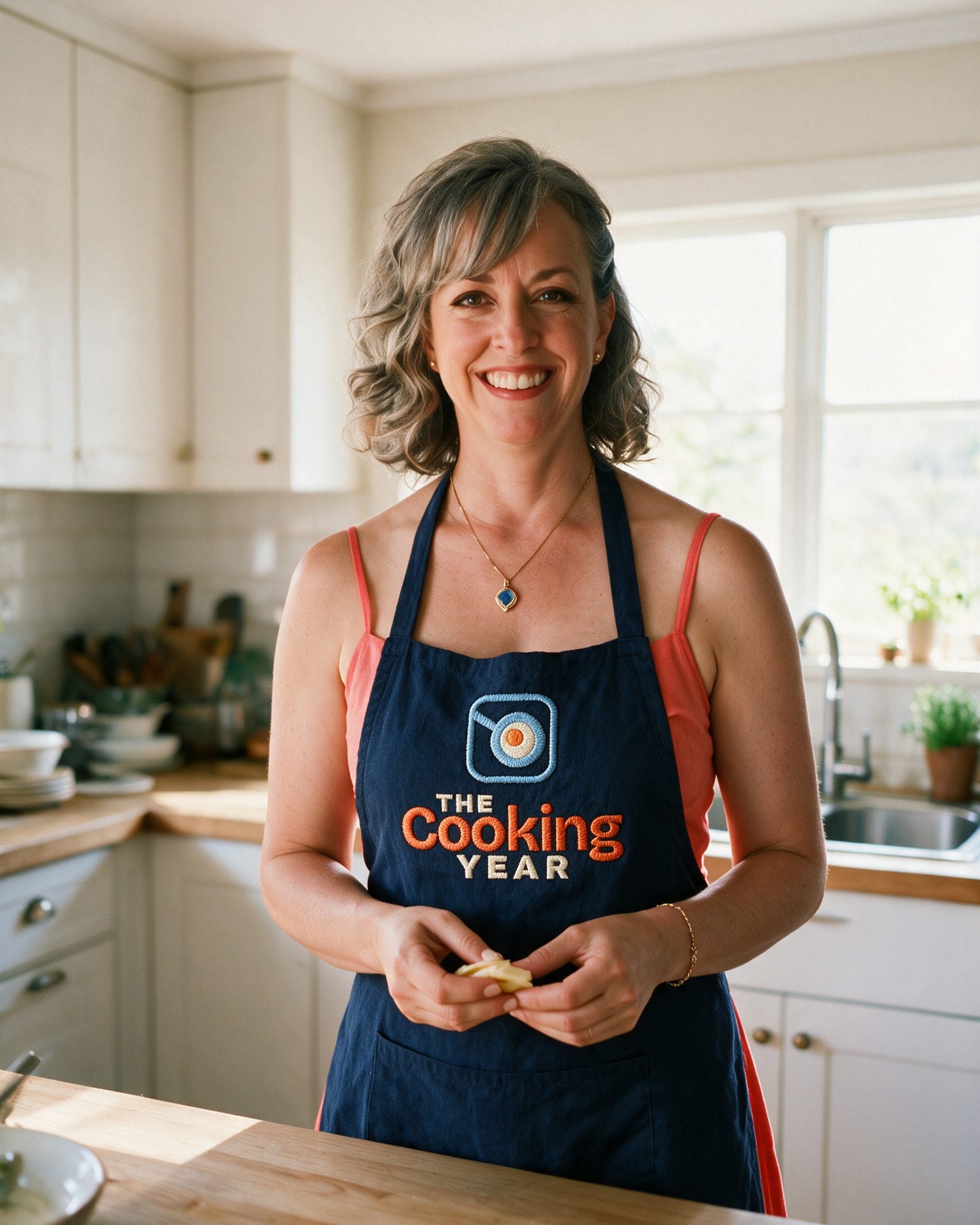
Holly Putnam smiling in her kitchen, wearing a navy Cooking Year apron

A module a month. A lesson a week. Real food every time.

A new module opens about once a month. Inside it are four weekly lessons, one for each week until the next module arrives.

Each week your student watches a video with Holly, then cooks. The groceries are the ones you already buy: produce, meat, eggs, dairy, dried beans, rice, spices, and flour.

Everything released stays open all year, and if you enroll late, every module released so far opens the day you join.

Most families buy these. Your student will make them, from scratch.

Every one of these shows up in most kitchens in a jar, a can, a packet, or a box. In The Cooking Year, each one gets made from real ingredients.

  • ◆Pancakes, not a mix
  • ◆Vinaigrette, not bottled dressing
  • ◆Mac and cheese from a real béchamel, not a blue box
  • ◆Taco seasoning, no packets
  • ◆Dried beans and from-scratch chili
  • ◆Ranch dressing
  • ◆Chicken stock, from the carcass of the chicken they roasted
  • ◆Tomato sauce, from crushed tomatoes and aromatics
  • ◆Biscuits, dumplings, cornbread
  • ◆Fresh salsa, guacamole, pico, refried beans
  • ◆Yellow cake and vanilla buttercream
  • ◆Pie crust and real whipped cream

All aspects of cooking are covered, even budgeting. Your student prices meals by the serving, shops a week of meals, and cooks a dinner for the family for ten dollars or less.

Fun for kids and parents.

Your student cooks real food in the first lesson and every lesson after, works through nine modules with names like First Fire and Mission Control, earns a badge for each one, and finishes the year by cooking a feast they designed themselves.

If you have the time, this course is most effective when a parent joins in. Not only can you observe and help guide the exercise, you will likely learn something new yourself. And the bonus is, by the end of the year, you will have hours of side-by-side time with your student. You will be amazed at the conversations and connection that come out of that.

One enrollment covers every student in your house.

The Cooking Year is licensed for an entire family. Enroll once and every student in your household is covered for the full 2026–27 school year, whether that is one kid or ten.

An eight-year-old and a sixteen-year-old can work the same lesson. Younger students watch with a parent and cook alongside them. Older students are able to run the lesson on their own, but we encourage parental involvement.

The year at a glance.

One module a month, four lessons in each.

MonthModuleWhat they learn
1First FireSafety, tools, knife skills, measuring
2Flavor CodeHeat, fat, salt and acid, the flavor base
3Good EggEggs, breakfast timing, roux and béchamel
4Meat WorksGround beef, roast chicken, big cuts, dried beans
5Green MachineVegetables, salads, potatoes, rice and grains
6Pot LuckStock, stew, sauces, biscuits and cornbread
7PassportMexico, Italy, Asia, France
8Mission ControlMeal planning, budget shopping, batch cooking, running the kitchen
9Feast MasterBaking, pie, cooking without a recipe, the Feast

Everything the year needs.

  • ◆36 video lessons with Holly
  • ◆9 module badges and a printable badge board
  • ◆Weekly parent guides with shopping lists and tools lists
  • ◆A printable recipe card for every lesson
  • ◆The Kitchen Atlas and Glossary
  • ◆The Menu Planning Worksheet
  • ◆Transcript template and completion certificate

Enroll for 2026–27.

One enrollment, one price, the whole household.

That is $397 for the whole household for the whole school year. Thirty-six weeks of a teacher in your kitchen, and a kid who can cook at the end of it. One student or four, one price.

$3972026–27 school year

The Cooking Year

You get everything released so far the moment you join, and every module as it opens. Module 1 opens September 1, 2026.

Enroll now

As low as $33/month with full payment. Installments available.

Questions before you enroll.

What if we enroll late?

Every module released so far opens the moment you enroll. You will never be locked out of something the rest of the group already has. The only thing you can't do is get ahead of modules that haven't opened yet.

How long do we have access?

At least twelve months from the day you enroll. A family joining in the spring still has a full year to work through everything, same as everyone else.

Can I use this for more than one child?

Yes. One enrollment covers every student in your household for the full school year. Kids at different ages work the same lesson; younger ones with a parent alongside, older ones on their own.

Do I need to be a good cook?

No. But you might become one. Holly teaches the lessons. You need to be nearby, keep an eye on the knife and heat weeks with younger students, and be present to help find answers to questions.

When does each part of the course open?

A new module opens about once a month across the school year, and each one holds four weekly lessons. Everything already released stays open all year.

What equipment do we need?

A normal home kitchen. The course names the ten tools worth owning, plus the instant-read thermometer that saves more dinners than any of them, and covers how to buy them without overspending. Nothing specialty is required at any point in the year.

Does my student cook alone, or do I need to be in the kitchen?

Your call, and it changes with age, but we encourage it. Younger students should have an adult right there, especially in the knife and heat weeks. Older students can work on their own. Ten lessons across the year are built as Side by Side lessons, where the parent cooks alongside the student, usually because a second pair of hands makes the dish easier.

How does this fit on a transcript?

The Cooking Year is a 1-credit Culinary Arts / Life Skills elective across 36 weeks. A transcript template and completion certificate are included on request.

Do you offer a guarantee?

We want every family to be satisfied with the course and with the progress their student is making. If you have any concerns, send us a message and we will do everything we can to make it right.

They'll learn to cook by heart.

By the end of 36 weeks, they'll cook by heart. No recipe required.